
A buyer sources a hard case with a published IP67 rating. The case arrives. The buyer drops it into a meter of water for 30 minutes. Water gets in. The supplier insists the case is IP67-rated and points to the datasheet. The buyer insists the case leaked. Both are correct — and the gap between published rating and reproducible rating comes down to three manufacturing steps that the O-ring supplier cannot control.
Key Takeaways
- An O-ring seal on a protective case is not a commodity part — sealing performance depends on three manufacturing variables: groove geometry, compression ratio at closure, and latch assembly torque.
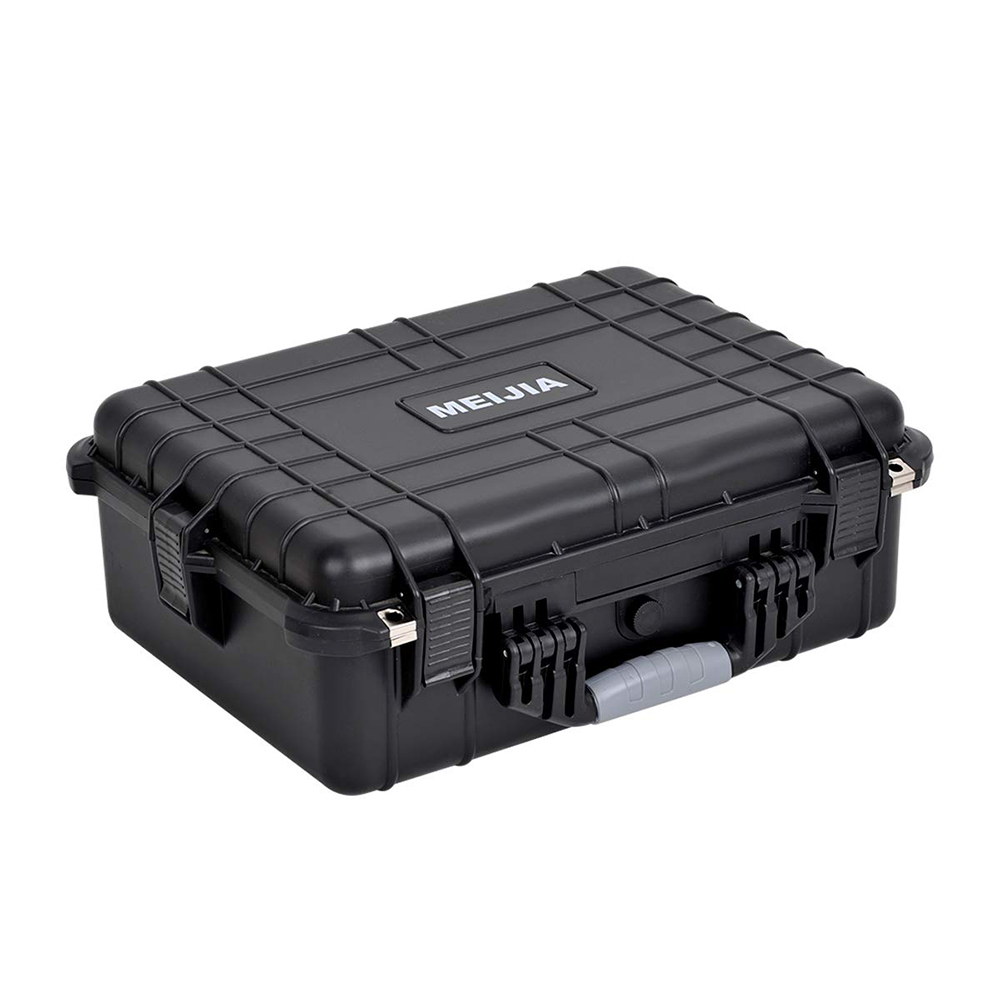
- Meiqi controls all three variables as part of the production process for the protective case product line, anchored to the IP67-rated Hazardous Environment Protective Case (MJ-1520-6060) and the protective box category.
- The Meiqi factory was established in 1998, holds 196 patents, and is ISO 9001 and ISO 14001 certified with German GS recognition — supporting OEM buyers who need process-controlled manufacturing, not generic protective cases.
- The three manufacturing steps — groove geometry design, compression ratio at closure, latch assembly torque — are the difference between a published IP rating and a reproducible IP rating across production batches.
Table of Contents
This guide consolidates the three manufacturing steps that determine whether a protective case achieves its published IP rating, anchored to Meiqi’s product line.
Why O-ring Seals Are Not Commodity Parts
An O-ring is a piece of rubber. It can be purchased by the thousand from any number of rubber product suppliers. On a datasheet, two O-rings with the same material, same cross-section, and same inner diameter look identical. In production, two O-rings from the same supplier can deliver very different sealing performance depending on three manufacturing variables that the O-ring supplier does not control.
The three variables are: the case groove geometry (depth, width, surface finish, corner radius), the compression ratio at closure (how far the lid is pulled down toward the case body when latches are engaged), and the latch assembly torque (the controlled force applied during production assembly). The same O-ring from the same supplier can deliver IP67 in a properly designed case assembled with controlled torque, and fail at IP54 in a sloppy case assembled with feel-based tightening.
For OEM buyers sourcing protective cases from China, the implication is clear. The audit should not focus on which O-ring the supplier uses. The audit should focus on the three manufacturing steps that turn an O-ring into an IP-rated seal.
Step 1: Groove Geometry Design
The first manufacturing step is groove geometry design. The O-ring sits in a groove machined or molded into the case body or lid. The groove dimensions determine how the O-ring is compressed when the case is closed, and how the compressed O-ring reacts to pressure differentials.
Groove Dimensions by O-ring Cross-Section
| O-ring Cross-Section | Groove Width | Groove Depth | Corner Radius | Surface Finish (Ra) |
|---|---|---|---|---|
| 1.5 mm | 2.0-2.3 mm | 1.05-1.15 mm | 0.2-0.4 mm | 0.4-0.8 µm |
| 2.0 mm | 2.6-2.9 mm | 1.35-1.50 mm | 0.2-0.5 mm | 0.4-0.8 µm |
| 2.5 mm | 3.3-3.6 mm | 1.70-1.85 mm | 0.3-0.5 mm | 0.4-0.8 µm |
| 3.0 mm | 3.8-4.2 mm | 2.0-2.2 mm | 0.3-0.5 mm | 0.4-0.8 µm |
The groove width is typically 1.05 to 1.10 times the O-ring cross-section, allowing the O-ring to sit in the groove without rolling under compression. The groove depth is set so that the O-ring is compressed 20-30 percent when the lid is fully closed. The corner radius prevents the O-ring from being cut during assembly. The surface finish affects friction during installation and seal performance under pressure.
Why Geometry Matters
A groove that is too wide allows the O-ring to roll or shift under compression, creating gaps where water or dust can pass. A groove that is too deep under-compresses the O-ring, leaving insufficient sealing force. Sharp corners cut the O-ring during lid closure. Rough surface finish creates leak paths that bypass the O-ring contact area.
The Meiqi factory inspects groove geometry on every molded case body before O-ring installation. Cases with groove flash, surface defects, or dimensional out-of-specification are rejected and re-molded. This inspection step is documented in the production log.
Step 2: Compression Ratio at Closure
The second manufacturing step is compression ratio at closure. When the case lid is closed and latched, the O-ring is squeezed between the groove wall and the lid contact surface. The compression ratio — the percent reduction in O-ring cross-section from free state to closed state — determines the sealing force.
Compression Ratio by Application
| Application | Compression Ratio | Sealing Force | Use Case |
|---|---|---|---|
| Light dust protection | 10-15 percent | Low | IP5x dust-protected only |
| General industrial | 20-25 percent | Medium | IP65 / IP66 splash-resistant |
| Waterproof transport | 25-30 percent | High | IP67 immersion 1 m / 30 min |
| Extended immersion | 28-32 percent | Higher | IP68 deeper / longer immersion |
Under 20 percent compression, the O-ring does not conform to surface irregularities on the lid contact area and may leak under pressure. Over 30 percent compression, the O-ring material is over-stressed and may crack or permanently deform, reducing sealing performance over repeated closure cycles.
Why Compression Ratio Matters
The compression ratio at closure is not determined by the O-ring itself. It is determined by the case design — specifically, the gap between the groove bottom and the lid contact surface when the lid is closed. This gap is set during mold design and is fixed for the life of the mold.
If the gap is too large (lid does not press down far enough), the O-ring is under-compressed and the case leaks. If the gap is too small (lid presses down too far), the O-ring is over-compressed and may fail after a few closure cycles. The mold design must specify this gap precisely, and the mold must be maintained to keep the gap within tolerance.
Step 3: Latch Assembly Torque
The third manufacturing step is latch assembly torque. The latches pull the lid down toward the case body and hold it in position. The torque applied to the latch fasteners determines how tightly the lid is held, which in turn affects the compression ratio of the O-ring at closure.
Latch Torque by Case Size
| Case Size Category | Latch Torque | Tool Type | Operator Skill Required |
|---|---|---|---|
| Small (under 12 inches) | 5-8 N·m | Calibrated pneumatic | Low (tool-controlled) |
| Medium (12-24 inches) | 8-12 N·m | Calibrated pneumatic | Low (tool-controlled) |
| Large (24-36 inches) | 10-14 N·m | Calibrated pneumatic | Low (tool-controlled) |
| Extra-large (over 36 inches) | 12-16 N·m | Calibrated pneumatic | Low (tool-controlled) |
The Meiqi factory uses calibrated pneumatic torque tools for all latch assembly. The tools apply torque within ±5 percent of the target across all latches and all production units. Manual feel-based tightening is not used.
Why Torque Matters
Production variability is higher than most buyers realize — latch torque varies 10-20 percent across operators, tools, and shifts. The same case on Monday and Friday can have meaningfully different O-ring compression.
For a buyer shipping precision instruments, medical equipment, or measurement tools, this variability is a quality risk. A case that passes IP67 on the production line may fail IP67 in the field because the latch torque was not consistent. The solution is tool-controlled torque, not operator skill.
O-ring Material Selection
The O-ring material selection affects chemical compatibility, temperature range, and aging resistance — but does not affect the manufacturing steps above. Common O-ring materials for protective cases include:
| Material | Temperature Range | Chemical Resistance | Typical Application |
|---|---|---|---|
| NBR (Nitrile) | -30°C to +110°C | Good for oils, fuels | General industrial / military |
| EPDM | -50°C to +150°C | Good for water, steam | Cold chain / medical / outdoor |
| Silicone | -60°C to +230°C | Good for food, medical | Pharmaceutical / food-grade |
| Viton (FKM) | -20°C to +200°C | Excellent for chemicals | Chemical / oil & gas / defense |
| HNBR | -40°C to +150°C | Better than NBR for heat | Automotive / aerospace |
Material Cost Trade-Off
NBR is the lowest cost O-ring material, 30-50 percent less than Viton or HNBR. For general industrial use, NBR delivers the right balance. Specifying Viton or HNBR on a general-purpose case is over-engineering.
For most cases, NBR is standard. The 25 percent compression at -30°C to +110°C covers typical range. For cold chain (medical at 2-8°C), EPDM provides better low-temperature flexibility. For chemical exposure, Viton provides chemical resistance.
Common Production Defects
Beyond the three manufacturing steps, production defects can reduce the IP rating even when the design is correct.
Mold Flash on the O-ring Groove
Mold flash is thin plastic residue left on the case body after molding. If the flash is in or near the O-ring groove, the flash prevents the O-ring from sitting properly in the groove and creates a leak path. Inspection and deflashing of every case body is a required production step.
O-ring Damage During Installation
O-rings can be cut, twisted, or pinched during installation into the groove. A damaged O-ring does not seal even if the groove geometry is perfect. Installation should be done by trained operators with proper tooling, not by general assembly staff.
Lubricant Contamination
O-ring lubricant (typically silicone grease) helps the O-ring slide into place during installation and lid closure. Too much lubricant causes the O-ring to slip out of the groove during closure. Too little lubricant causes the O-ring to twist or pinch. Lubricant quantity should be controlled per case, not estimated.
Latch Wear Over Time
Latches wear with repeated use. A latch that delivered 12 N·m torque when new may deliver 9 N·m after 500 cycles. For applications where the case is opened and closed frequently, latch wear should be monitored and latches replaced at defined intervals.
IP67 vs IP68: What the Rating Actually Tests
IP67 and IP68 differ in the immersion test conditions defined by IEC 60529. Understanding the difference is important when specifying a protective case.
IP67 Test Conditions
IP67 requires the case to prevent ingress of water in harmful quantity when immersed to 1 meter depth for 30 minutes. The test setup uses a water tank with the case submerged on a support grid. After the test, the case is opened and inspected for water ingress. IP67 is the standard rating for transport and field deployment scenarios.
IP68 Test Conditions
IP68 requires the case to prevent ingress at depths and durations specified by the manufacturer. Typical IP68 ratings specify 2-3 meters depth for 1-2 hours of continuous immersion. IP68 is required for sustained underwater use — diving equipment, marine research instruments, or any application where the case will be submerged for an extended period.
Engineering Difference
The engineering difference between IP67 and IP68 is in the O-ring compression, the case wall thickness, and the latch design. IP68 typically requires 28-32 percent O-ring compression (vs 25-30 percent for IP67), 1-2 mm additional wall thickness in the case body, and latches rated for higher torque capacity.
The Meiqi factory produces both IP67 and IP68 rated cases in the protective case line. The IP67 rating is standard for the MJ-1520-6060 and the broader protective box category; IP68 is available on selected models with reinforced case walls and heavier-duty latches.
Closing Note
O-ring seals are not commodity parts. The sealing performance of a protective case depends on three manufacturing steps: groove geometry design, compression ratio at closure, and latch assembly torque. The same O-ring from the same supplier can deliver different IP ratings depending on how these three steps are controlled in production. For OEM buyers sourcing protective cases from China, the audit focus should be on the three manufacturing steps, not on the O-ring brand or material. For a deeper look at how OEM buyers audit case suppliers for measurement-grade applications, see the companion article on a German measurement OEM’s case audit.
About the Author
Alice is Export Sales Manager at Ningbo Meiqi Tool Co., Ltd., a manufacturer of hard case boxes and tool storage solutions established in 1998. With over 500 product varieties including waterproof protective cases, tool boxes, rifle cases, and camera cases, the factory serves North America, South America, and Eastern Europe. ISO9001 and ISO14001 certified, with German GS recognition and 196 patents, Meiqi specializes in ODM and OEM partnerships for brands seeking reliable, high-quality tool and protective case suppliers from China.
Connect: Meijia Case on Facebook | Company Profile | Product Range
Post time: Jul-29-2026