

Introduction
As supply chains grow more demanding and portable equipment becomes more valuable, the quality of a protective box has a direct effect on product safety, compliance, and customer trust. This article explains why strong OEM capability matters when brands need durable, precision-made storage solutions for tools, electronics, medical devices, and other sensitive assets. It also outlines how MeiqiCase supports brand partners through engineering, manufacturing, and quality control that reduce risk and improve performance. With that context in place, the discussion turns to the market pressures, technical standards, and production strengths that define high-quality portable tool storage today.
Why Protective Box OEM Excellence Is a Strategic Requirement
The global industrial packaging and storage market is undergoing a profound transformation, shifting from basic transit containers to highly engineered, structural enclosures. For brands that manufacture or distribute sensitive electronics, medical devices, aerospace components, or precision portable tools, securing an OEM partnership for a high-quality Protective Box is no longer a peripheral procurement task. It has become a core strategic requirement that directly impacts product integrity, brand reputation, and end-user satisfaction.
As equipment complexity increases, the cost of transit damage or environmental degradation scales exponentially. An elite OEM partner provides more than just manufacturing capacity; they deliver advanced polymer engineering, precise tooling capabilities, and rigorous quality control frameworks. By leveraging specialized OEM excellence, brands can offload the heavy technical and capital burdens of injection molding and compliance testing, allowing them to focus entirely on their core product innovations while ensuring their hardware is protected by best-in-class storage solutions.
Market pressures driving higher OEM standards
The demand for superior protective solutions is being driven by stringent global supply chain requirements and the escalating value of portable industrial equipment. The compound annual growth rate (CAGR) for high-performance protective cases is projected to exceed 6.5% over the next five years, fueled by sectors that operate in extreme environments. When transporting diagnostic equipment or tactical gear valued upwards of $50,000, the structural failure of a transit case is a catastrophic event.
Market pressures dictate that modern storage solutions must survive multidirectional impacts, prolonged submersion, and extreme thermal shock. Consequently, brands are abandoning commodity plastic totes in favor of engineered protective cases. This shift forces OEMs to elevate their manufacturing standards, investing in advanced automation, superior resin blends, and rigorous testing protocols to meet the zero-defect expectations of industrial and military-grade clients.
How suppliers differentiate through manufacturing capability
In a saturated manufacturing landscape, top-tier suppliers differentiate themselves not through aggressive pricing, but through verifiable manufacturing capability and material science expertise. Leading OEMs utilize modified Polypropylene (PP) copolymer blends rather than standard Acrylonitrile Butadiene Styrene (ABS), achieving a superior strength-to-weight ratio and enhanced cold-weather impact resistance. Furthermore, elite manufacturers maintain injection molding tolerances of ±0.15 mm, ensuring watertight seals and perfectly aligned hardware.
Differentiation is also evident in an OEM’s internal infrastructure. Suppliers that maintain in-house mold design and fabrication facilities can iterate faster and control the lifecycle of the tooling. By guaranteeing mold lifespans of 300,000 to 500,000 shots, these manufacturers provide brands with long-term production stability. The ability to seamlessly integrate custom secondary operations—such as automated CNC foam routing, custom color compounding, and integrated pressure equalization valve assembly—separates true strategic partners from basic injection molding job shops.
What Defines a High-Quality Protective Box
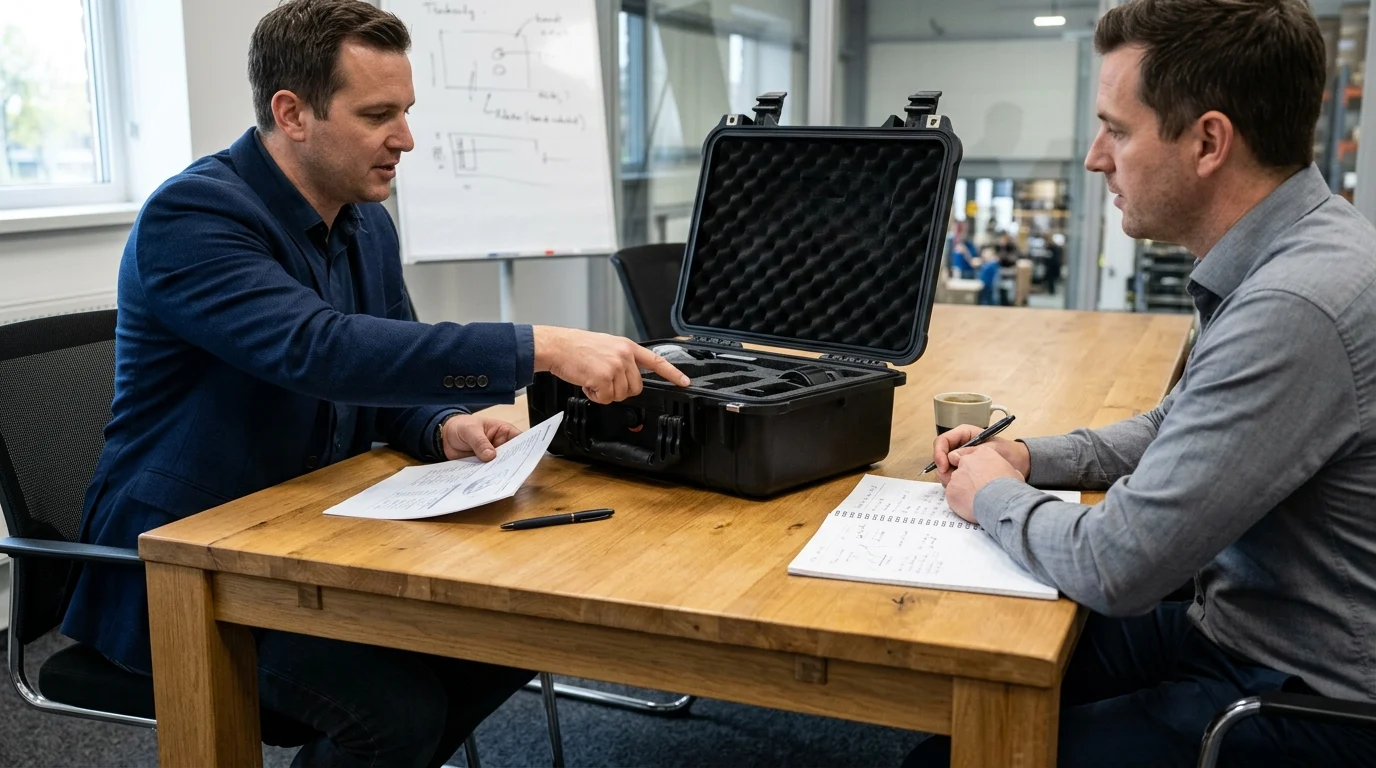
Defining quality in the context of a protective case requires looking far beyond aesthetic ruggedness to verifiable structural and environmental performance. Brands must evaluate prospective storage solutions against rigorous engineering metrics to ensure the final product can withstand the specific operational hazards of its intended use case.
Key technical specifications to evaluate
The benchmark for a high-quality transit solution is defined by its ingress protection and mechanical durability. Industry-standard cases must achieve at least an IP67 rating, guaranteeing complete protection against dust ingress and survival during water submersion at a depth of 1 meter for 30 minutes. Advanced models may push this to IP68 for prolonged submersion. Mechanically, the enclosure should meet an IK08 or higher impact resistance rating, meaning it can withstand a 5-joule impact without compromising the structural integrity of the shell or the environmental seal.
Thermal stability is another critical specification. High-performance polymer blends must maintain their mechanical properties across a temperature spectrum ranging from -40°C to 90°C. Additionally, load-bearing capacity is paramount; a professional-grade case should support a static stacking load of up to 150 kg to survive the crushing forces often encountered in palletized air freight and military logistics.
| Specification | Standard Consumer Case | High-Performance OEM Case |
|---|---|---|
| Wall Thickness | 2.5 mm – 3.0 mm | 4.0 mm – 5.5 mm |
| Ingress Protection | IP54 / IP55 | IP67 / IP68 |
| Impact Resistance | IK06 | IK08 / IK10 |
| Temperature Range | -10°C to 60°C | -40°C to 90°C |
| Stacking Load | < 50 kg | > 150 kg |
Case design, foam engineering, and hardware considerations
The external polymer shell is only one half of the protection equation; internal foam engineering is equally vital. High-quality OEMs offer precision-engineered inserts using Ethylene-Vinyl Acetate (EVA) or Polyurethane (PU) foams. For heavy industrial tools, EVA with a density ranging from 35 kg/m³ to 45 kg/m³ provides optimal shock absorption and resistance to chemical solvents. The foam must be CNC routed or waterjet cut to exact tool dimensions, eliminating micro-vibrations during transit.
Hardware considerations significantly impact the longevity of the case. High-quality designs utilize dual-throw latches that provide a mechanical advantage, ensuring a secure closure with minimal user effort while preventing accidental opening upon impact. Hinge pins and latch axles must be manufactured from 304 or 316-grade stainless steel to prevent galvanic corrosion in maritime environments. Furthermore, an integrated automatic pressure equalization valve, utilizing a hydrophobic ePTFE membrane, is essential to prevent vacuum lock after altitude or temperature changes.
How brands should compare suppliers
When brands compare potential manufacturing partners, they must evaluate the depth of the supplier’s testing validation and customization capabilities. A premier Equipment Shipping Protective Transit Case manufacturer will provide documented evidence of MIL-STD-810G or ATA Spec 300 compliance, proving their designs have survived standardized drop, vibration, and environmental tests.
Brands should also assess the precision of the supplier’s O-ring sealing technology. The integration of a continuous, seamless EPDM or silicone gasket inside the lid groove is a hallmark of superior case design. By comparing tooling costs, cycle times, and the ability to execute complex co-molding (such as rubberized over-molded handles), brands can accurately identify suppliers capable of delivering uncompromising quality.
How Protective Box OEM Development Works
The pathway from industrial design to mass production requires a highly synchronized workflow. Navigating the OEM development process effectively allows brands to bring robust, customized storage solutions to market rapidly while mitigating the financial risks associated with complex plastic injection molding.
Typical workflow from concept to production
The OEM development lifecycle begins with comprehensive 3D CAD modeling, typically utilizing software like SolidWorks or Siemens NX to map out the exact geometry of both the external shell and the internal payload. Once the digital twin is approved, the workflow moves to rapid prototyping. High-resolution SLA 3D printing or CNC machining is used to produce physical prototypes within 7 to 10 days, allowing the brand to verify ergonomics, component fitment, and aesthetic appeal.
Following prototype approval, the most critical phase—steel mold fabrication—commences. Depending on the complexity and size of the case, tooling production requires between 35 and 50 days. The manufacturer then executes a pilot run to produce T0 (first out of tool) and T1 samples. These samples undergo rigorous inspection to identify any flash, sink marks, or dimensional inaccuracies. Only after the T2 or T3 samples are fully validated against the engineering drawings does the project transition into full-scale mass production.
Balancing speed, customization, and cost
Brands must constantly balance speed to market against the degree of customization and total capital expenditure. Utilizing an off-the-shelf case shell and customizing only the internal EVA foam and external branding is the fastest route, reducing development time to just 15-20 days with minimal upfront costs. Custom foam inserts can be produced with Minimum Order Quantities (MOQs) as low as 100 units.
Conversely, developing a fully bespoke case geometry requires significant capital investment, with custom injection molds ranging from $15,000 to over $40,000 depending on the cavitation and steel grade (e.g., P20 vs. NAK80). While this approach extends the timeline by 60 to 90 days, it provides the brand with exclusive IP, perfectly optimized dimensions, and tailored structural reinforcements. Brands must weigh their projected annual volume against these tooling amortization costs to determine the most viable path.
Steps to reduce development risk
To reduce development risk and prevent costly tooling modifications, expert OEMs employ Design for Manufacturing (DFM) and Mold Flow Analysis before cutting any steel. DFM identifies potential manufacturing defects, such as uneven wall thicknesses that cause warping or insufficient draft angles that complicate part ejection. Mold Flow Analysis simulates the injection process to optimize gate locations and cooling channels, ensuring structural uniformity.
Furthermore, physical risk is mitigated through pre-production environmental testing. Before committing to mass production volumes, pilot samples should be subjected to MIL-STD-810G transit drop testing (typically 26 drops from 1.2 meters onto concrete) and submersion tests. Identifying a latch failure or gasket breach at the pilot stage saves brands from catastrophic product recalls and supply chain disruptions later in the lifecycle.
Which Quality, Compliance, and Supply Chain Factors Matter Most
A robust product design is ultimately meaningless without the stringent manufacturing controls necessary to ensure consistency across tens of thousands of units. Evaluating a partner’s quality assurance frameworks and supply chain resilience is critical for maintaining uninterrupted product availability and regulatory compliance.
How to assess manufacturing quality systems
Assessing an OEM’s quality system begins with verifying their foundational certifications, most notably ISO 9001:2015. However, true manufacturing excellence requires looking deeper into their daily operational controls. Brands should evaluate the supplier’s Acceptable Quality Limit (AQL) standards. A tier-one manufacturer will strictly enforce a 1.5 Major / 4.0 Minor defect threshold, targeting an overall production defect rate of less than 0.3%.
Advanced quality assessment also involves reviewing the supplier’s incoming material inspection (IQC), in-process quality control (IPQC), and final quality control (FQC) protocols. The use of automated coordinate measuring machines (CMM) to verify the dimensional accuracy of the molded parts against the original CAD files ensures that batch-to-batch variance remains within the strict ±0.15 mm tolerance required for IP67 sealing.
Compliance, packaging, and export requirements
Compliance with international material and environmental regulations is non-negotiable for global distribution. The polymers, colorants, and internal foams used in the case must comply with REACH and RoHS directives, ensuring they are free from restricted heavy metals and hazardous chemicals. Failure to secure these compliance certificates can result in entire shipments being impounded by customs authorities in the European Union and North America.
For the transit sector, adherence to specific packaging standards is highly advantageous. Cases engineered to meet the ATA Spec 300 Category 1 standard are certified to withstand a minimum of 100 transit cycles, a crucial metric for aviation and heavy logistics sectors. Additionally, OEMs must provide certified UN packaging codes if the cases are intended to transport hazardous materials or volatile lithium-ion battery arrays.
Lead times, MOQs, and logistics planning
Understanding the logistical parameters of a partnership is essential for inventory planning. Standard MOQs for protective cases typically range from 300 to 500 units for standard colors like black or olive drab. However, custom Pantone color matching usually pushes the MOQ to 1,000+ units due to the necessity of purging the injection molding machines between color runs. Production lead times for repeat orders generally stabilize between 25 and 35 days.
| Supply Chain Metric | Semi-Custom (Foam/Color) | Fully Custom OEM Tooling |
|---|---|---|
| Minimum Order Quantity (MOQ) | 300 – 500 units | 1,000 – 2,000+ units |
| Prototype Lead Time | 7 – 10 days | 15 – 20 days (post-CAD) |
| Tooling Production Time | N/A | 35 – 50 days |
| Mass Production Lead Time | 15 – 20 days | 25 – 35 days |
| Typical Defect Rate Target | < 0.5% | < 0.3% |
Effective logistics planning also requires optimizing pack-out density. Because protective cases are high-volume, low-weight items, shipping them efficiently is a challenge. OEMs that provide intelligent palletization strategies and nested packaging solutions can significantly reduce TEU (Twenty-Foot Equivalent Unit) container utilization, directly lowering the landed cost per unit for the purchasing brand.
How to Choose the Right Protective Box OEM Partner
Selecting the optimal manufacturing partner requires an objective evaluation of long-term strategic alignment rather than a simple unit-cost comparison. The right OEM acts as an extension of a brand’s own engineering and logistics teams, safeguarding product integrity from the factory floor to the end user.
Criteria that separate strategic partners from suppliers
The criteria that separate true strategic partners from standard commodity suppliers revolve around vertical integration and engineering support. A partner like MeiQi Protective Box provides comprehensive in-house capabilities, encompassing mold design, injection molding, foam routing, and final assembly. This vertical integration eliminates the compounding delays and quality risks associated with outsourcing sub-components to third-party job shops.
Financial stability and scalability are equally critical. A strategic partner must possess the capital infrastructure to invest in multi-cavity tooling and automated robotic extraction arms as a brand’s volume scales. Furthermore, top-tier OEMs offer proactive value engineering—continuously suggesting material alternatives or design tweaks that reduce cycle times and material waste without compromising the IP67 rating or structural integrity.
Building an effective sourcing framework
To formalize the selection process, procurement teams should build a weighted sourcing scorecard. A highly effective framework allocates 40% of the decision weight to engineering and in-house tooling capabilities, ensuring the supplier can execute complex geometries and maintain tight tolerances. Total landed cost, including tooling amortization and freight optimization, should account for 30%.
The remaining weight should be divided between quality assurance systems (20%) and supply chain flexibility (10%). By systematically evaluating potential partners against these rigorous metrics, brands can confidently secure an OEM relationship that delivers uncompromising protection, regulatory compliance, and long-term market competitiveness for their most valuable equipment.
Key Takeaways
- The most important conclusions and rationale for Protective Box
- Specs, compliance, and risk checks worth validating before you commit
- Practical next steps and caveats readers can apply immediately
Frequently Asked Questions
What makes an OEM protective box high quality?
Look for IP67 or higher sealing, strong impact resistance, stable performance from -40°C to 90°C, and precise molding tolerances that keep the lid, latch, and gasket aligned.
Why choose an OEM partner instead of a standard plastic case supplier?
An OEM partner can customize shell size, foam inserts, colors, valves, and branding while maintaining consistent quality for long-term production runs.
Which materials are better for portable tool storage cases?
Modified PP copolymer is often preferred over basic ABS because it offers a better strength-to-weight ratio and improved cold-weather impact resistance.
How can brands verify a protective box will survive shipping and field use?
Ask for test data on IP rating, impact performance, temperature range, stacking load, and production tolerances before approving samples or mass production.
Can protective box OEM production include custom interior protection?
Yes. A qualified supplier can add CNC-routed foam inserts, equipment cutouts, and internal layouts tailored to portable tools, electronics, or sensitive instruments.
Post time: May-25-2026